By Usharbudh Arya (Swami Veda Bharati)
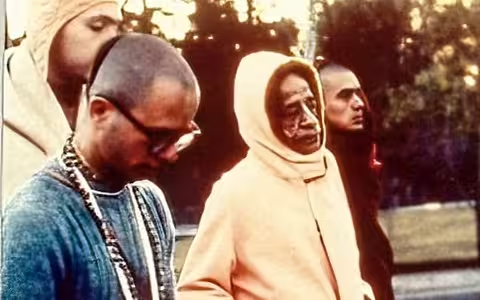
When I was initiated onto the path of the Solar Science, I used to have many questions to ask my guru.
At that time my master was trying to found a Meditation Centre in the United States. I would call him on the phone and say: “Swamiji, I have this question… and this question… and this question.” He would answer: “Write all your questions down carefully on a piece of paper, and when I come to Minneapolis I will answer them one by one.”
When he arrived at the Minneapolis Centre that we had established together, he would address the group and tell them that I was his main disciple; but when I asked him for a little time to give answers or solutions to my concerns and doubts, he would tell me he had no time, he would surround himself with many students and would not say a word to me. Finally he would say: “Today I can't; tonight, come at 10:30 and I will surely answer all your questions.” At night, by the time I arrived where he was, he was already surrounded by many disciples and he would repeat: “I'm sorry, I'm busy now, tomorrow…” And then he would add: “Tomorrow at 10:30.” The next day I would again return at the appointed hour and once more I found the same scene: he was surrounded by his disciples. He would repeat again: “Oh, I'm sorry! I love you very much but… today I can't… tomorrow.” And the story repeated itself for some three or four more days.
Today, being at the head of all those students, as Director of the Minneapolis Centre, I remember how on that occasion, when I had arrived at the room where the students were gathered with my guru, he said to them: “Very well. Everyone please leave. Now it is my turn.” My master took a seat and, smiling, invited me to make myself comfortable and then said: “Well, ask your questions.” I always used to carry with me the little paper with the questions written down, not knowing when my master would decide to answer them. So, putting my hand in my pocket, I took out my questions, but when I read them they seemed so silly to me! I felt pensive, not knowing what to do, and my master insisted: “Now ask your questions.” I remained silent. And the master insisted more: “Now ask your questions.” I remained silent. And the master insisted even more: “Now ask your questions.” I took out the paper and put it back in my pocket. I smiled… and did not answer, and I said to him: “I have no more questions.” And the master touched my forehead and smiled. He said nothing more. That is how the great masters teach. And I could tell you whole episodes in which my master transmitted wisdom to me. He taught me to be calm.
As his disciple, I lived in his Ashram doing the small things he needed. The house had two floors and he occupied a room on the second floor. On one occasion he called me to his room. I hurried up the stairs and, when I reached his room, he said to me: “I want you to get me a phone call.” I took the telephone in the room, but he, in a somewhat serious tone, said to me: “Not from there — from downstairs, I want it from there!” I ran down, and when I was about to make the call, I heard him shouting: “Usharbuddh… Usharbuddh!” I went back up the stairs and he said to me: “Sit down and write this letter that I am going to dictate to you.” I had not yet begun the new task when he said: “Did you make the call?” I immediately protested: “But Swamiji…!” He simply said to me: “Remain calm.” And I understood what he wanted to teach me.
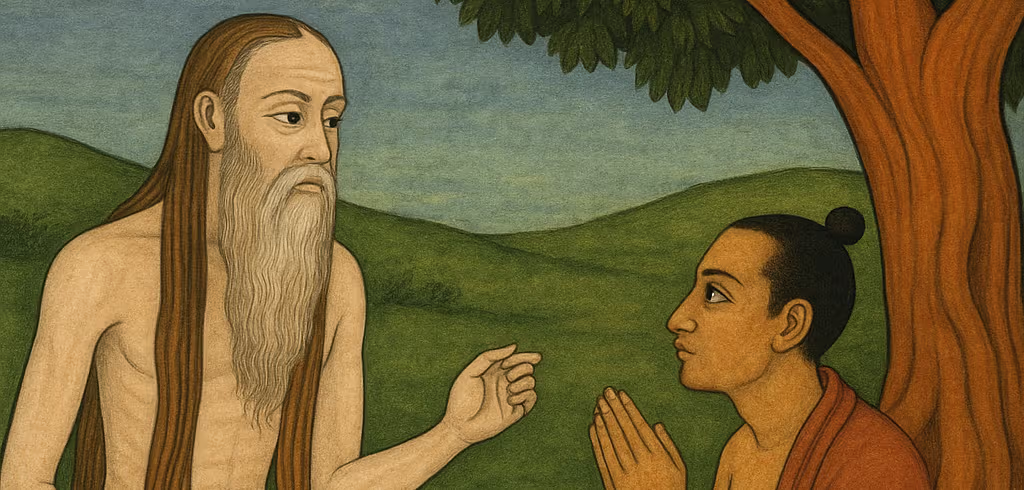
Masters put us through these difficulties and then they teach us. He does not sit down to give lessons. They instruct us in the School of Life. To be in close contact with a master is a problem! It cleanses the disciple of dross and purifies his mind. One cannot boast of being strong enough to withstand the fire of the test; for the master knows precisely the disciple's weaknesses. And those he fights with full rigour.
I remember on one occasion when my master sent me a letter in which, with harsh criticism, he accused me of having no inspiration: he told me I was no good, that my lectures were empty, that my books were meaningless, that they said nothing. Two condemnatory pages with this kind of criticism. I took the letter, read it and then put it away, but I sent no reply. The next day, he calls my wife and asks her: “Did Usharbuddh receive my letter?”
—Yes, Swamiji, my wife answers. He insists: “Didn't he get upset?”
—No, Swamiji, my wife answers again. Finally he adds: “How is it possible that he did not get upset?” After two days he calls again. My wife answers the phone: “Has he seen my letter?” asks my master.
—Yes, Swamiji, my wife answers.
—“Was he upset?” asks my master.
—He did not get upset, my wife answers.
In this way a master tests his disciple. Then the disciple is ready for the next step.
A master always teaches us through what we call a riddle: they place us between two conflicting situations, and one has to know how to solve the problem. Life also teaches in the same way: through the conflicts of life, the Eternal Guru constantly presses us to resolve the paradoxes. And that is precisely what the word SAMADHI means: to resolve.
I hope that all of you come to fulfil your purpose in this life. It does not matter if you achieve it a second before your death. If you do so, you will have triumphed.